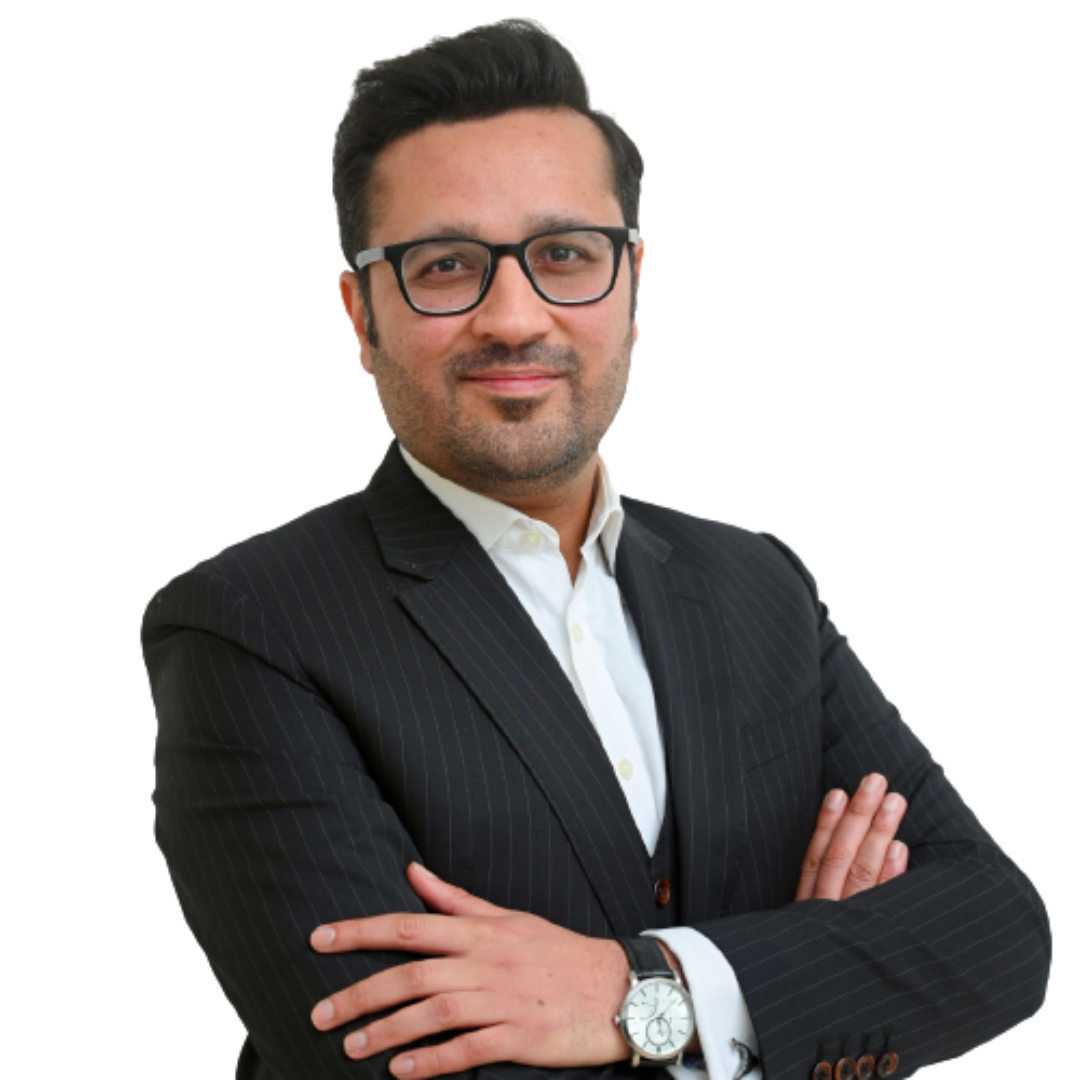
Safi Ghauri grew up across more than seven cities and several countries. His father is a Harvard alumnus, a high-ranking judge, and a career civil servant — the kind of trajectory that moves a family across continents and never permits the assumption that any single city is the whole world. By the time he left for London, he had already learned what most lawyers spend a career trying to acquire: that every room has its own rules, and the person who reads them fastest wins.
'Every room has its own rules, and the person who reads them fastest wins.'
The Making of a Practitioner
He qualified as a barrister at Lincoln's Inn and holds two masters degrees from City St George's, University of London. Before returning to Pakistan, he trained at Clyde & Co in London and at international commercial law firms in New York and Orlando. It gave him a working model of how international practice actually operates, not how it is described in textbooks.
He founded Esquare Legal in 2009. Technology law as a formal practice area barely existed in Pakistan at the time. He built it anyway, in the conviction that the country's economic future would be decided by whether its legal infrastructure could keep pace with its technology sector.
The Cases That Shaped the Practice
The early years were not spent waiting for the fintech revolution to arrive. While building the technology practice, he was simultaneously handling cases that were reshaping Pakistani legal history. His LLM thesis was extensively cited in the NRO judgement, specifically on the recovery of illegal proceeds. That body of work remains directly relevant today: cryptocurrency has become one of the most significant instruments for the movement of illicit capital globally, and he is among the few practitioners who understands both the legal architecture of recovering laundered proceeds and the technical infrastructure through which those proceeds now move.
In May 2016, he filed the first-ever Panama Leaks case in Pakistan's Election Commission on behalf of a PTI client against Captain Safdar. It was the legal template that Imran Khan's team replicated in their Supreme Court petition weeks later. He spent months in ECP and Supreme Court proceedings as the case became the most consequential political litigation in Pakistan's modern history.
He served as lead counsel for the Jang/Geo Group in defamation proceedings that produced Pakistan's largest-ever defamation award of Rs100 million. He also represented all associations of Pakistan International Airlines — collectively over 300,000 employees — in the PIA privatisation challenge.
He successfully carried out a high stakes case in the Supreme Court of India in a successful cryptocurrency matter before three of the court's senior-most judges. These cases established something important: he was not a technology lawyer who occasionally appeared in court. He was a litigator with the range to operate at the highest level of any matter he took on.
Building the Fintech Industry
The regulatory work that followed did not merely advise on frameworks that already existed. It built them. His firm secured Pakistan's first-ever Buy Now, Pay Later licence from the Securities and Exchange Commission for QisstPay, in 2021. There was no precedent for the application when it was filed.
The firm also established the lending fintech sector in Pakistan and holds more NBFC licences than any other legal practice in the country. Across the full arc of Pakistan's digital financial regulation — from the earliest SECP fintech frameworks until the formation of PVARA — Esquare was in the room at state level before the institutions that would govern the industry had been formally constituted. He has advised both the companies seeking licences and presented directly to the regulators issuing them. That dual perspective is not common.
International Expansion
The practice expanded outward through a series of roles that each added a different dimension to his operational picture. As Vice President of Legal and Compliance at Fasset in Dubai, he secured the firm's VARA licence, one of the earliest and most comprehensive virtual asset licences issued by Dubai's regulator. As Head of Legal at Klink Financial in Berlin, he worked across crypto offerwall and digital asset product structures spanning EU and US markets.
His current portfolio of active mandates includes RWA Inc, a leading global real-world asset tokenisation platform; Tharwa, an Islamic stablecoin project; and InvoiceMate, one of the UAE's leading fintech platforms. These are not advisory engagements. They are embedded, retainer-based relationships where he functions as General Counsel at board level.
The most significant structural step was the Tahota partnership. Tahota Law Firm is one of China's top-100 global law firms with 4,000+ practitioners, 30+ offices across Asia, the US, and Australia, headquartered in Chengdu. Esquare Legal held the official law firm mandate for the Chinese Embassy in Pakistan, for the Chinese Overseas Association, and for the Chinese Business Association in Pakistan. The firm led the RUDA project, a $4.8 billion Chinese infrastructure initiative representing one of the largest Chinese investment projects outside China at the time of execution.
'He was not a local counsel being instructed by a Chinese firm. He was the partner.'
Brazil
In 2024, Safi relocated to São Paulo and established Esquare Legal's Brazil presence. The decision was not incidental. Chinese capital is flowing into Brazilian agriculture, infrastructure, and energy at a pace that most of the MENA legal world has not yet noticed. The MENA-to-Brazil corridor is equally underserved. He is now inside both of those flows simultaneously — present, registered, and advising on the cross-border transactions that neither side fully understands yet.
In addition, Brazil serves as a LATAM base in a growing digital assets market that promises to be the next frontier for crypto. São Paulo is where the next chapter of the practice is being written.
The Analyst
Running parallel to the legal career — not alongside it, not separate from it, but genuinely parallel — is a fifteen-year record as a political and legal analyst. Over 300 broadcast appearances as a political and legal analyst, including as a regular contributor to Pakistan TV, the country's international channel. Topics spanning national security postures, South Asian strategic dynamics, the geopolitics of financial regulation, and the Middle East in active conflict.
He trained at Pakistan's National Defense University, the institution that forms Pakistan's senior military officers and strategic studies scholars. He is Pakistan TV's officially appointed South America Correspondent, reporting from São Paulo. This is not commentary for its own sake. The geopolitical analysis feeds directly into the legal and advisory work — and it is how he identifies where the risk is before his clients have to ask.
The Speaking Record
He has spoken on digital assets regulation at the Horasis Global Summit with 1,000 leaders from 50 countries. At COP30 in Belém, on blockchain infrastructure for climate finance. At the European Commission and UNIDROIT's DARTE expert series, on MiCA and Travel Rule implementation across Latin America. He has trained judges and prosecutors for UNODC. He has panelled at FATF. He has spoken at Stellar Meridian at the Copacabana Palace and at ETH Latam.
'In the rooms where the frameworks are being argued, not the rooms where they are being explained.'
The Person
He is a deep-sea diver and loves rock music. A serious coffee, tea and yerba mate drinker. Someone who has been described as Pakistan's most prolific tech lawyer — a description he accepts as historically accurate and strategically insufficient.
He speaks English, Urdu and Hindi fluently, Mandarin and Portuguese conversationally. His Chinese cultural fluency — the understanding of protocol, hierarchy, and what is said between the lines in a Chinese business meeting — runs considerably deeper than his spoken language. He works best on problems that have no clean jurisdictional answer.